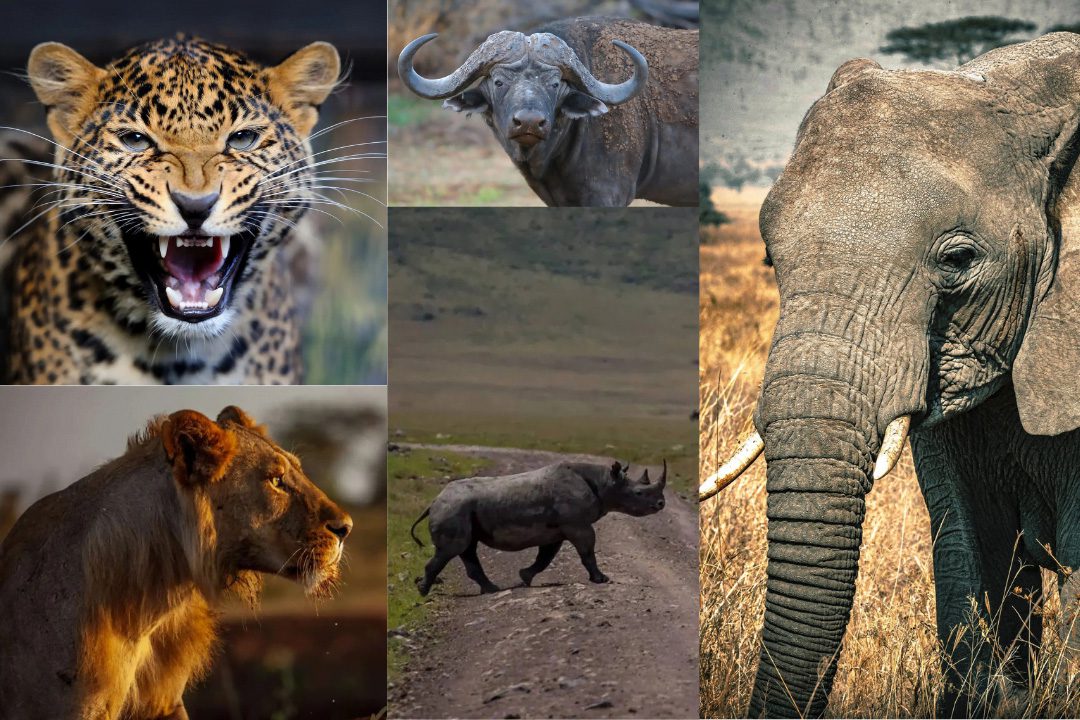
Almost everyone planning their first African safari has heard the term “Big Five.” It shows up on every tour brochure, in every travel magazine, and at the entrance of nearly every reserve in southern and eastern Africa. But what are the Big Five, exactly and where do you actually go to see them?
This guide covers the term’s original meaning, the five species themselves, where each is best viewed, and how to structure a safari to see all five.
Where the term comes from
The “Big Five” was coined in the 19th and early 20th centuries by big-game hunters and not because of the animals’ size. The term referred to the five African species considered the most dangerous and difficult to hunt on foot: lion, leopard, elephant, rhinoceros, and Cape buffalo.
These five earned their reputation not through size alone, but through a combination of unpredictability, intelligence, defensive aggression when wounded, and the ability to seriously injure or kill a hunter. A wounded buffalo, for example, was widely considered more dangerous than a lion.
The term outlived the hunting era and migrated into safari tourism, where it now describes the species most travelers want to photograph rather than shoot. The Big Five remain the headline act of any African safari, and seeing all five in a single trip is considered the classic milestone for first-time visitors.
A note on what’s not on the list: cheetah, hippo, crocodile, and giraffe are all magnificent and frequently more dangerous to humans than some of the Big Five (hippos kill more people in Africa each year than any other large mammal). They simply weren’t on the original hunters’ list.
1. Lion
The lion is the only truly social big cat. Prides typically consist of related females, their cubs, and one or more coalition males, and they hunt cooperatively in ways that no other large predator does.
What to look for on safari:
- Pride dynamics: watch how the females coordinate, how males patrol the territory boundaries, and how cubs interact
- Hunting behavior: lions hunt mostly at dawn and dusk; mid-day sightings are usually sleeping prides
- Vocalizations: the territorial roar of an adult male carries for miles and is one of the most visceral sounds in nature
Where to see lions
The Maasai Mara in Kenya and the Serengeti in Tanzania hold some of the highest lion densities in Africa and are reliable for sightings year-round. The Mara’s open grasslands make for the most photogenic encounters — a pride on a kopje (rocky outcrop) at sunrise is the postcard image.
The Kruger National Park in South Africa and the surrounding private reserves (Sabi Sands, Timbavati) also deliver excellent lion sightings, with the added advantage of off-road driving in the private concessions that allows much closer approaches.
Best season: predator activity peaks during the dry months when game concentrates around water. For the Mara and Serengeti, June through October; for southern Africa, May through September.
2. Leopard
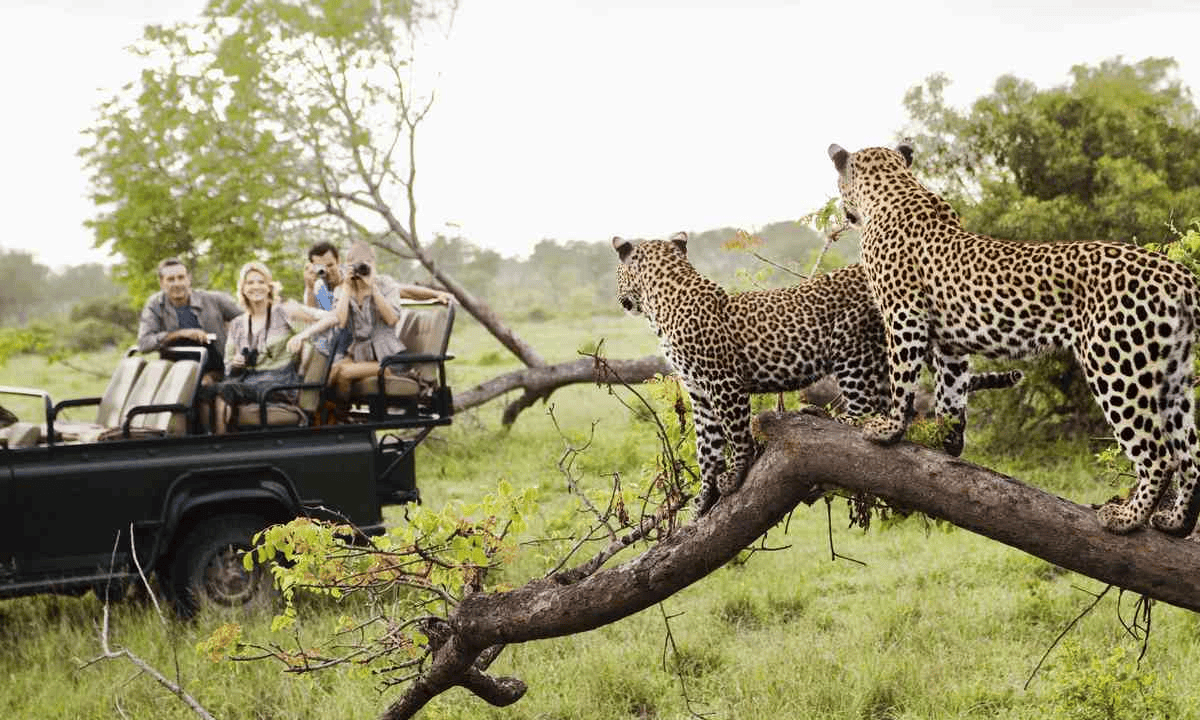
Of all the Big Five, the leopard is the hardest to find. Solitary, secretive, nocturnal, and the master of camouflage, leopards are present in habitats across most of sub-Saharan Africa, but actually spotting one requires luck, an excellent guide, and ideally a region where the leopards have been habituated to vehicles over many years.
What makes a leopard sighting special:
- The hoist: leopards drag kills into trees to keep them away from lions and hyenas. Finding a leopard with a kill stashed in a marula or sausage tree is a signature safari moment.
- The stalk: leopards hunt by stealth, and a guided sighting where you watch a leopard slowly close on a duiker or impala is unforgettable.
- The eyes: leopards have one of the most arresting gazes in the animal kingdom, pale gold, unflinching, and aware.
Where to see leopards
Sabi Sands Private Game Reserve in South Africa is widely considered the best leopard viewing on the continent. Decades of low-impact tourism have produced leopards that ignore vehicles entirely, and sightings of stalking, hunting, and feeding behavior are routine.
The Maasai Mara, particularly along the Talek and Mara rivers, also offers excellent leopard sightings. Several individual leopards in the conservancies are well-known to guides and habituated to vehicles.
South Luangwa in Zambia is another top leopard destination, particularly for night drives — Zambia is one of the few countries where night game drives in national parks are permitted, and leopards are dramatically more active after dark.
Best season: leopards are present year-round, but the dry season improves visibility because the grass is shorter and tree foliage is thinner.
3. Elephant
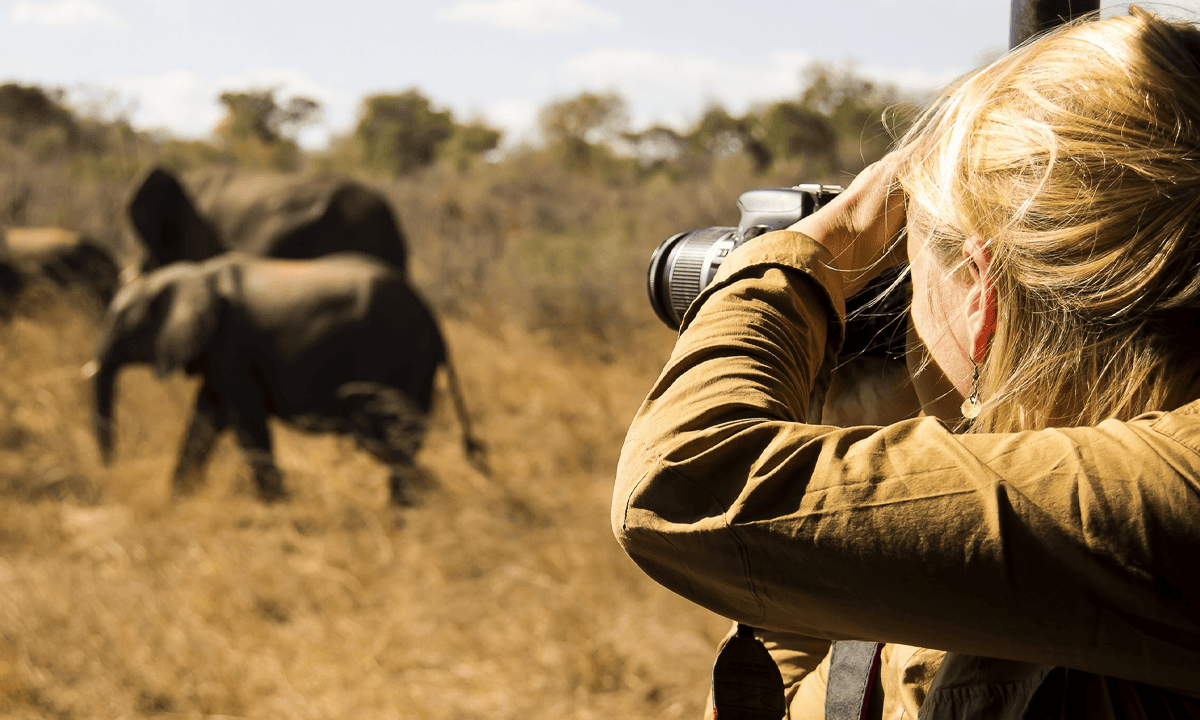
The African elephant is the world’s largest land animal and arguably the most emotionally complex. Family groups are matriarchal, led by an older female who passes generations of knowledge — water locations, migration routes, threat recognition — down to the rest of the herd.
A close elephant encounter often shifts the way travelers think about wildlife. The intelligence is visible. The grief behaviors when a herd member dies are real and well-documented. The personalities of individual animals are obvious within minutes of watching them.
What to look for:
- Herd structure: identify the matriarch, the juveniles, and how the herd moves to protect the calves
- Tusk variation: older bulls develop massive tusks; some populations have genetic “tuskless” females, an increasingly common adaptation in heavily poached regions
- Bull behavior: mature males live solitarily or in loose bachelor groups, and their behavior is completely different from breeding herds
Where to see elephants
Amboseli National Park in Kenya is the iconic elephant destination — open plains with massive herds and Mount Kilimanjaro as a backdrop. The Amboseli elephants are among the most studied in the world.
Chobe National Park in Botswana hosts what may be the densest elephant concentration on Earth during the dry season. Boat cruises on the Chobe River in July and August routinely produce herds of 50 to 100 animals at the water.
Hwange in Zimbabwe, Tarangire in Tanzania, and Addo Elephant Park in South Africa are all outstanding alternatives.
Best season: dry season concentrates elephants around remaining water, making sightings highly reliable.
4. Rhinoceros
The rhino is the hardest of the Big Five to see — not because they’re shy, but because there are simply far fewer of them. Poaching for rhino horn has devastated populations across the continent. Black rhino numbers have rebounded modestly from a 1990s low of around 2,400, but they remain critically endangered. White rhino numbers, while higher, have come under renewed pressure in recent years.
Both species can be seen on safari, but you need to go to the right places.
Where to see rhinos
Kruger National Park and adjacent private reserves in South Africa have historically held the world’s largest rhino populations. Sabi Sands in particular is a strong rhino destination, though sightings have become more sensitive due to poaching.
Ol Pejeta Conservancy in Kenya is the headquarters of African rhino conservation. The conservancy hosts the world’s only two remaining northern white rhinos (both female, both elderly, kept under 24-hour armed guard) and has one of the largest black rhino populations in East Africa.
Hluhluwe-iMfolozi Park in South Africa pioneered white rhino conservation in the 1960s and is one of the most reliable places on the continent to see them.
Etosha National Park in Namibia is excellent for black rhino, particularly at floodlit waterholes after dark.
Best season: rhinos are year-round residents. The dry season improves overall visibility, but the bigger factor is choosing a reserve with a strong rhino population.
5. Cape Buffalo
The Cape buffalo is the Big Five member that tourists most often underestimate — and the one that has earned the deepest respect from guides. A solitary old bull (a “dagga boy”) is one of the most genuinely dangerous animals on the continent, with a documented willingness to charge without warning and circle back to attack pursuers.
In herds, buffalo are also impressive: 500 to 1,000 animals moving across a plain is one of the great safari sights, and the dust they raise can be visible from miles away.
What to look for:
- Herd dynamics: sentinel bulls on the perimeter, calves protected in the center, females leading the movement
- Dagga boys: older males pushed out of herds, often found in small bachelor groups near water; identifiable by their massive worn-down horns
- Predator interactions: lions hunt buffalo regularly, and watching a hunt unfold (or a buffalo herd successfully defend against one) is among the most dramatic safari experiences
Where to see buffalo
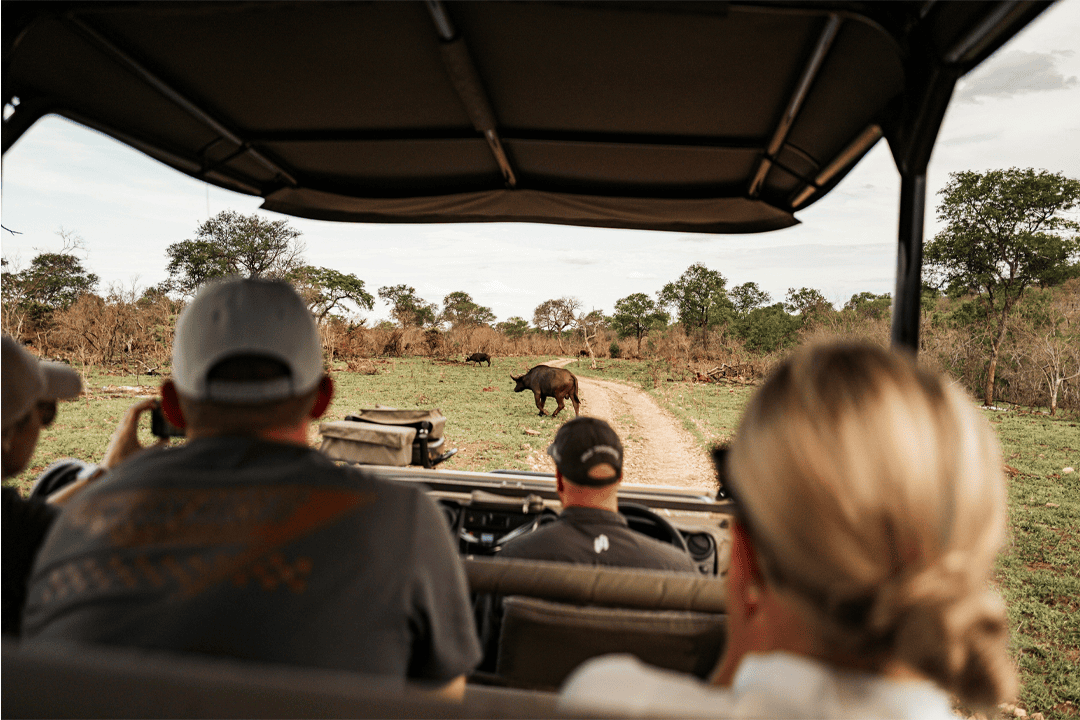
Buffalo are common across most of sub-Saharan Africa’s protected areas. Kruger, the Serengeti, the Maasai Mara, Moremi, Chobe, and South Luangwa all hold large populations. Buffalo are usually the easiest of the Big Five to find — but the quality of the sighting (a large herd in good light, or a tense lion-buffalo interaction) is what makes the difference.
Best season: dry season concentrates herds near water; green season disperses them but produces dramatic landscape photography.
Best safari seasons by species
| Species | Peak Season | Best Region |
| Lion | Dry (Jun–Oct EA, May–Sep SA) | Maasai Mara, Serengeti, Sabi Sands |
| Leopard | Dry season, year-round | Sabi Sands, Mara, South Luangwa |
| Elephant | Dry season | Amboseli, Chobe, Hwange |
| Rhino | Year-round (dry preferred) | Kruger, Ol Pejeta, Hluhluwe |
| Buffalo | Dry season | Kruger, Serengeti, Moremi |
How to plan a Big Five safari
The good news: seeing all five in a single trip is achievable. The bad news: it requires a thoughtful itinerary, not just one camp.
The single-park option: Kruger and its private reserves (especially Sabi Sands) is the most reliable Big Five destination in Africa. A well-run camp with experienced guides can deliver all five in three to four days. If you want the simplest possible Big Five trip, this is it.
The combined East Africa option: The Maasai Mara delivers lion, leopard, and buffalo at high reliability. Add Amboseli for elephants and Lake Nakuru or Ol Pejeta for rhinos and you have a complete Big Five trip with the bonus of seeing the Great Migration (in season).
The Southern Africa loop: Botswana’s Moremi delivers four of five reliably, with rhinos requiring either a Kruger add-on or a visit to Khama Rhino Sanctuary in Botswana itself.
For first-time travelers building their first safari, our plan your African safari section walks through how to structure a trip around your wildlife priorities including the practical question of how many days you need at each park to maximize Big Five chances.
For options on lodging, our safari lodge accommodation page lists properties matched to the Big Five hotspots in each country.
If you’re still narrowing down which country to visit, our breakdown of the best African safari destinations covers all the major regions.
For travelers comparing East African options specifically, our regional guides cover safari in Kenya and safari in Tanzania in depth.
Ready to plan your Big Five safari?
Whether you want the most efficient possible Big Five trip — three or four days in a top private reserve — or a longer East-and-Southern Africa journey that hits all five plus the Great Migration, we can build the itinerary around exactly what you want to see.
Reach out to start planning. We’ll match the parks, lodges, and seasons to your priorities and tell you honestly which combinations work and which ones don’t.