Africa is enormous. Most travelers planning their first safari don’t realize quite how enormous the continent is, large enough to contain the United States, China, India, Europe, and most of South America combined. So “going on safari in Africa” is roughly as specific as “going on vacation in the Americas.”
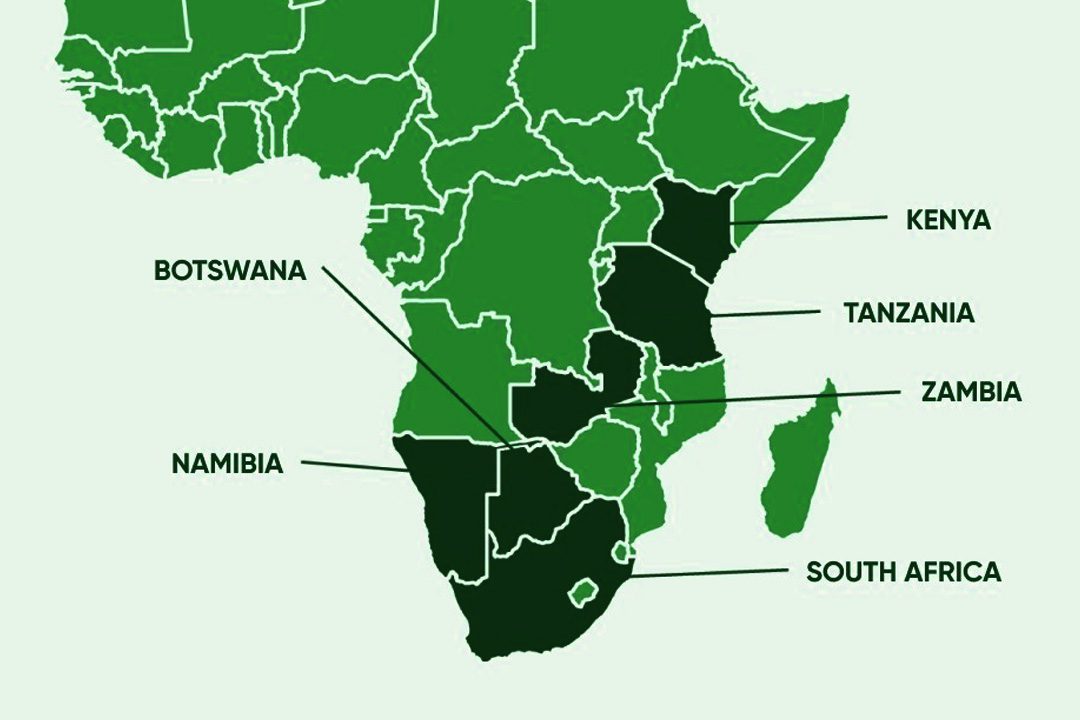
This guide uses the map of Africa as a navigation device. We’ll break the continent into the two regions where the vast majority of safari travel happens — East Africa and Southern Africa — and walk through what each country in those regions actually offers. By the end, you’ll have a clear sense of which part of the map matches the safari you want.
Reading the safari map
If you mentally divide Africa horizontally, three things become clear:
- The northern third (Sahara, Sahel, Mediterranean coast) has no significant safari industry.
- Central Africa (Congo Basin, Gabon, CAR) has incredible biodiversity but very limited tourism infrastructure — it’s a specialist territory for forest elephants and gorillas, not a classic safari.
- The eastern and southern thirds are where 95% of safari travel happens. Within those two regions, a manageable list of about ten countries delivers nearly every famous safari destination.
That gives us the working map: East Africa (Kenya, Tanzania, Uganda, Rwanda) and Southern Africa (Botswana, South Africa, Zimbabwe, Zambia, Namibia, with Mozambique as a beach add-on).
Both regions deliver a world-class safari. They just deliver it differently.
East Africa
East Africa is the safari of the cultural imagination — open grasslands, big cats on koppies, the Great Migration thundering across the Mara River, Maasai warriors in red shukas, snow-capped equatorial peaks. It’s where the safari industry began, and it remains the region that most first-time travelers think of when they hear the word.
Kenya
Kenya is the most accessible safari country in East Africa and arguably the easiest entry point on the continent. Nairobi is well connected to the US, Europe, and Asia, and the country’s parks are mature, well run, and offer the highest density of safari options at every price point.
Key Kenyan safari regions:
- Maasai Mara — the northernmost extension of the Serengeti ecosystem; July through October hosts the Great Migration; year-round excellent for big cats. Conservancies bordering the main reserve (Mara North, Olare Motorogi, Naboisho) offer off-road driving, night drives, and walking safaris.
- Amboseli — open plains beneath Mount Kilimanjaro; iconic for massive elephant herds, particularly old bulls with enormous tusks.
- Samburu — semi-arid north; home to species you won’t find further south, including reticulated giraffe, Grevy’s zebra, gerenuk, and Beisa oryx.
- Lake Nakuru — Rift Valley alkaline lake; flamingos when conditions are right, plus reliable rhino sightings.
- Laikipia — private conservancies in the central highlands; conservation-focused tourism, often combined with the Mara.
Tanzania
Tanzania is Kenya’s larger, wilder, and slightly more expensive sister. The country contains the Serengeti, Ngorongoro Crater, and Mount Kilimanjaro — arguably the three most famous wildlife and landscape destinations in Africa.
Key Tanzanian safari regions:
- Serengeti National Park: the southern half of the Great Migration ecosystem; calving season in the southern plains (January-March) is one of the most extraordinary wildlife events on Earth; river crossings in the western corridor and northern Serengeti happen May through October.
- Ngorongoro Crater: a collapsed volcanic caldera holding one of the densest concentrations of game in Africa, including the country’s most reliable black rhino sightings.
- Tarangire: dry-season elephant magnet with iconic baobab trees and far fewer vehicles than the Serengeti.
- Selous (Nyerere) and Ruaha: southern circuit parks; vastly less visited, more remote, excellent for travelers who want a quieter experience.
The Great Migration corridor
The Great Migration is the headline wildlife event of East Africa: roughly 1.5 million wildebeest, 200,000 zebra, and 350,000 gazelle moving in an annual 1,800-mile loop between the Serengeti and the Maasai Mara, chasing the rains and fresh grass.
The herds cross the Kenya-Tanzania border twice a year, northbound into the Mara around June-July, southbound back into the Serengeti around October-November. Combined Kenya-Tanzania itineraries that trace the migration corridor are a logical structure for travelers who want to follow the herds.
For a deeper breakdown of timing options across the region, see our guide to East Africa safari destinations and our broader guide to the best time to go on an African safari.
Southern Africa
Southern Africa is the safari for travelers who want diversity of experience. Instead of the savanna-and-acacia template of East Africa, Southern Africa stitches together delta water systems, desert dunes, mighty waterfalls, Big Five reserves, and one of the world’s great cities, all reachable in a single trip.
It’s also generally a more refined safari product. Camps are smaller, concessions are private, and the model leans toward exclusivity rather than volume.
Botswana
Botswana is the connoisseur’s safari. The country has deliberately built its tourism industry around low-volume, high-quality wilderness, resulting in some of the most pristine safari country on the continent.
Key Botswana regions:
- Okavango Delta: a 5,800-square-mile inland delta; safari from mokoro canoes, motorboats, and 4x4s; water-based game viewing you can’t get anywhere else in Africa.
- Chobe National Park: home to one of the densest elephant populations on Earth; the river boat cruise at sunset is a signature Southern African experience.
- Linyanti and Selinda: private concessions north of the Delta; outstanding for predator action, particularly wild dogs.
- Central Kalahari Game Reserve: vast and remote; best in green season when the pans fill and game disperses across the desert.
South Africa
South Africa is the most logistically efficient safari country on the continent. World-class infrastructure, easy international connections, English-speaking, malaria-free options, and a Big Five reserve (Kruger and its private concessions) that delivers the most reliable Big Five viewing anywhere in Africa.
Key South African safari regions:
- Kruger National Park and surrounding private reserves (Sabi Sands, Timbavati, Manyeleti, Thornybush) — the most concentrated Big Five experience available; Sabi Sands in particular for leopards.
- Madikwe Game Reserve — malaria-free, family-friendly, excellent for first-timers with kids.
- Kgalagadi Transfrontier Park — vast red-dune desert shared with Botswana; outstanding for predators and birds of prey.
- Cape Town — not safari, but almost every South African itinerary includes it; Table Mountain, the Cape Winelands, and the Cape Peninsula are an extraordinary urban-and-coastal contrast to time in the bush.
Zimbabwe and Zambia
These two countries share Victoria Falls, one of the seven natural wonders of the world. The Falls themselves can be experienced from either side — Zimbabwe’s side has the longer panoramic views, Zambia’s side has the more dramatic close-up experience including the famous Devil’s Pool.
Beyond the Falls:
- Hwange National Park (Zimbabwe) — vast Kalahari sandveld with massive elephant herds and excellent predator viewing.
- Mana Pools (Zimbabwe) — walking-safari country along the Zambezi River; for travelers who want to be on foot rather than in vehicles.
- South Luangwa (Zambia) — the originator of the walking safari; outstanding for leopards and night drives (Zambia is one of the few countries permitting night drives in national parks).
- Lower Zambezi (Zambia) — canoeing safaris on the Zambezi, with elephants on the riverbanks and good predator viewing inland.
Namibia
Namibia is the safari for travelers who care equally about landscape and wildlife. The country’s emptiness — fewer than three people per square kilometer — and its dramatic geography make it unlike anywhere else on the continent.
Key Namibian regions:
- Sossusvlei — the iconic red dunes of the Namib Desert; the photographic centerpiece of any Namibian trip.
- Etosha National Park — a vast salt pan and surrounding bushveld; world-class waterhole game viewing, particularly at night-lit waterholes.
- Damaraland — desert-adapted elephants, black rhino, and one of the most surreal landscapes in Africa.
- The Skeleton Coast — wild Atlantic coastline with shipwrecks and seal colonies.
Self-driving in Namibia is genuinely viable and common; the roads are good, the country feels safe, and the distances become part of the experience.
Mozambique
Not a primary safari destination, but the country’s Indian Ocean coastline — particularly the Bazaruto and Quirimbas archipelagos — is a popular beach extension after a Southern African safari. Snorkeling, diving, and relaxation after a week of early game drives.
For a more detailed breakdown of the region, see our guide to Southern Africa safaris and our curated safari lodge accommodation options across the region.
East Africa vs. Southern Africa: a side-by-side comparison
For travelers trying to decide between the two regions, this is the honest breakdown:
| Factor | East Africa | Southern Africa |
| Landscape | Open savanna, acacia, equatorial peaks | Delta, desert, bushveld, waterfalls, coastline |
| Signature wildlife event | The Great Migration | Big Five concentration, elephants at Chobe |
| Crowd levels (peak season) | High, especially Maasai Mara/Serengeti | Generally lower, especially Botswana and Namibia |
| Camp style | Mix of mid-tier and high-end; some larger lodges | Skewed toward small, exclusive properties |
| Price range (per person per night) | $300–$1,500+ | $400–$3,500+ |
| Ease of access | Direct flights to Nairobi from US/Europe | Often via Johannesburg or Cape Town |
| Malaria risk | Yes in most parks | Variable; SA has malaria-free options |
| Best for first-time travelers | Kenya | South Africa |
| Best for repeat travelers | Tanzania (southern circuit), Uganda | Botswana, Namibia |
| Best for families | Kenya (Mara), South Africa (Madikwe) | South Africa (Madikwe, Sabi Sands) |
| Best for luxury | Mara conservancies, Serengeti north | Botswana Delta, Sabi Sands |
| Best for value | Kenya (especially shoulder season) | South Africa (Kruger national park sections) |
Which region for which traveler
Choose East Africa if: you want the Great Migration, you have a strong mental image of open-plains safari (the cultural archetype), you want to combine wildlife with cultural depth (Maasai, Samburu), or you want gorilla trekking in Uganda or Rwanda as part of the trip.
Choose Southern Africa if: you want diversity of landscape in a single trip, you’re nervous about malaria and want some malaria-free options, you want to combine safari with a major city (Cape Town), or you’ve already done East Africa and want something different.
Combine both regions if: you have three weeks or more and want the most complete African experience available in a single trip. A typical structure: 7-10 nights in East Africa for the migration and big cats, then 7-10 nights in Southern Africa for the Delta or Cape Town and Kruger.
For the full list of countries and regions we operate in, see our all safari destinations page.
A note on countries not covered
Africa has safari opportunities beyond the two regions above. Ethiopia for the Simien and Bale mountains and endemic species. Madagascar for lemurs and unique flora. Congo and CAR for forest elephants and lowland gorillas. Mozambique for marine wildlife. These are all extraordinary, but they’re specialist trips that work best as second or third African experiences rather than first.
Ready to plan your African safari?
The map is just the starting point. The next step is matching the right combination of countries, parks, lodges, and timing to the trip you actually want — which depends on whether you’re chasing the migration, hunting the Big Five, traveling with kids, on a honeymoon, or somewhere on your fourth African trip and ready for somewhere new.
Visit our plan your safari page to start the conversation, or reach out directly. We’ll build the itinerary around the map points that matter most to you — and help you skip the ones that don’t.