
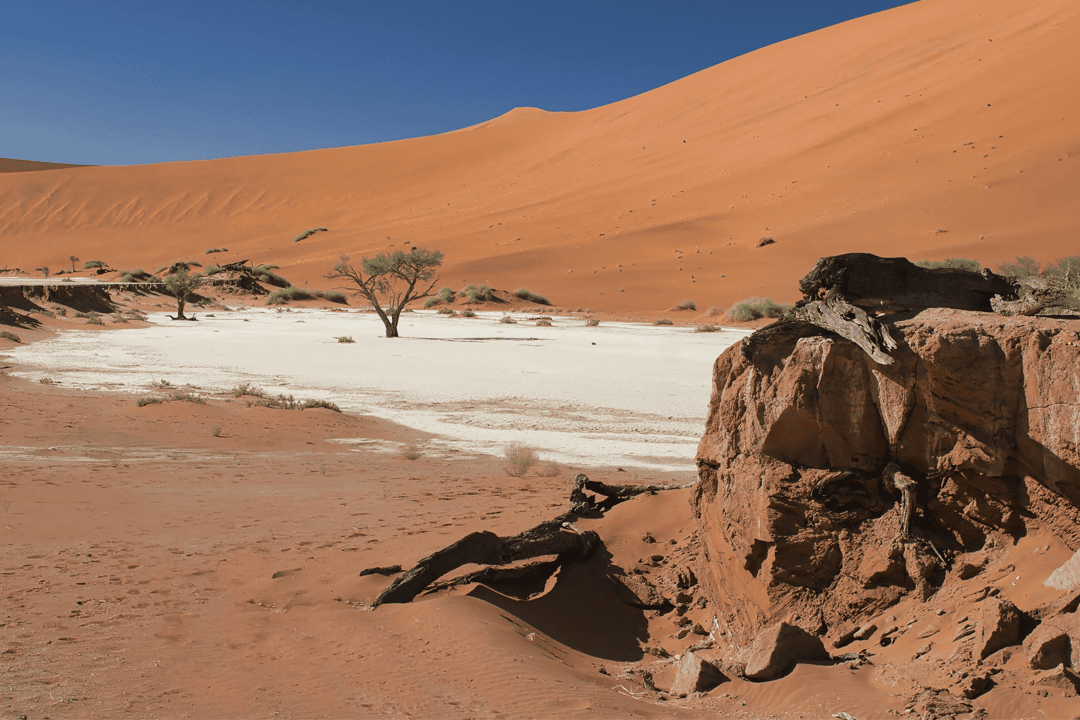
The classic mistake in planning a Namibia itinerary is underestimating the distances. On a map, Sossusvlei, the Skeleton Coast, and Etosha look like a tidy triangle. On the ground, they’re separated by six-hour gravel drives, and travelers who try to see all three in a week spend most of it in the car. Namibia rewards the itinerary that respects its scale, and punishes the one that doesn’t.
This guide builds the route properly: the loop that works for first-timers, how many nights each area actually needs, where to stay, and how it fits with the rest of Southern Africa.
The classic loop, and why it’s the right starting point
Nearly every good first-time Namibia road trip follows a clockwise loop from Windhoek: south to Sossusvlei and the dunes, northwest to Swakopmund and the coast, north through Damaraland, east into Etosha, and back to the capital. The loop works because each leg is a drivable day (four to six hours), the scenery changes completely at every stop, and the sequence builds from landscape toward wildlife.
Day 1: Windhoek. Arrive, collect the vehicle, and overnight. The capital is small and pleasant but not a destination; one night to recover from the flight is enough.
Days 2 to 4: Sossusvlei and the Namib (2 nights). Drive south through the Khomas Hochland and down the Spreetshoogte or Remhoogte pass into the desert, roughly five hours. Base yourself at Sesriem or at one of the lodges inside the Namib-Naukluft concessions. The single non-negotiable of the whole trip happens on your full day here: be at the park gate at sunrise for Sossusvlei and Deadvlei, when the dunes glow red and the shadows are deep. Climb Dune 45 or Big Daddy if you’re fit, walk out onto Deadvlei’s white clay among the ancient dead trees, and be done before the heat flattens everything by late morning. The second sunrise can go to a hot-air balloon flight over the dunes, one of the most spectacular balloon experiences anywhere.
Days 5 to 6: Swakopmund and the coast (2 nights). The drive northwest crosses the Namib’s gravel plains and the Tropic of Capricorn, with a stop at the Kuiseb Canyon viewpoint, before reaching the Atlantic, about five hours. Swakopmund is a surreal German-colonial town wedged between desert and cold ocean, and it’s where the trip changes gear: cooler temperatures, seafood, and the country’s adventure hub for quad biking and sandboarding on the dunes, skydiving, and a morning catamaran cruise from Walvis Bay for dolphins, seals, and pelicans. The Sandwich Harbor excursion, where dunes drop directly into the sea, is the standout half-day.
Days 7 to 8: Skeleton Coast and Damaraland (2 nights). Head north along the coast road past the shipwrecks and the enormous Cape fur seal colony at Cape Cross (tens of thousands of animals, and a smell you’ll remember), then turn inland into Damaraland. The full Skeleton Coast National Park is remote and mostly a fly-in experience; most road trips sample its southern stretch and then move to Damaraland’s lodges, where the attractions are the desert-adapted elephants tracked along dry riverbeds, the free-roaming black rhino, the Twyfelfontein rock engravings (a UNESCO site), and some of the strangest geology in Africa. Allow two nights so one full day goes to elephant tracking.
Days 9 to 11: Etosha (3 nights). East to Namibia’s great wildlife park, roughly four hours. Three nights is the right allocation, ideally split between the western or central camps (Okaukuejo for its famous floodlit waterhole) and the east (Namutoni or the private reserves on the eastern boundary), because Etosha is 130 miles across and the game viewing shifts along it. The method is simple and addictive: park at a waterhole and wait. In the dry season, elephant, lion, giraffe, zebra, and gemsbok rotate through on a schedule the animals seem to agree on, and after dark the floodlit waterholes deliver black rhino, often several at once.
Day 12: return to Windhoek. A five-hour drive back for an overnight and the flight home, or a direct connection if timing allows.
That’s a twelve-night loop. Tighten it to ten by dropping a coast night and a Damaraland night; stretch it to fourteen with a night at the Fish River Canyon in the far south or extra time in Etosha.
Self-drive or fly-in?
Most visitors self-drive Namibia, and for good reason: the gravel roads are well maintained, traffic is nearly nonexistent, navigation is simple, and the driving itself is part of the experience. Rent a 4×4 (a sedan technically manages the main routes, but the clearance and spare tires of a 4×4 remove the worry), carry water, fuel up at every opportunity, never drive at night (kudu on the road are a real hazard), and treat gravel with respect, since most accidents come from speed, not conditions.
Fly-in compresses the loop to seven or eight nights with light-aircraft hops between lodges, delivers the remote Skeleton Coast properly, and removes the driving fatigue. It costs substantially more and trades the road-trip freedom for efficiency. Travelers short on time, or those pairing Namibia with a second country, often choose it.
A sensible hybrid: self-drive the southern and coastal legs, then fly from Swakopmund or Damaraland into Etosha and back to Windhoek.
Best time to visit Namibia
The dry winter, May to October, is the prime window: clear skies, comfortable days, cold nights (near freezing in the desert in June and July), and Etosha’s waterholes at their most productive as the park dries out. July to September is peak demand, so book lodges early. The green months of November to April bring serious heat (Sossusvlei regularly tops 100°F), occasional dramatic storms, and lower rates; the dunes are magnificent year-round, but Etosha’s game disperses when rain fills the pans. For a first trip, May, June, September, or October bracket the high season with excellent conditions and slightly softer prices. For how that calendar sits against the rest of the continent, our guide on the best time for an African safari covers every region’s timing.
Combining Namibia with other countries
Namibia’s northeastern Zambezi Region (the former Caprivi Strip) is the hinge. From Etosha, the road east through Rundu and the Zambezi Region reaches the Botswana border, putting Chobe’s elephant herds and the Okavango Delta within reach; from Chobe, Victoria Falls is just over an hour away. The contrast is the appeal: Africa’s driest safari country followed by its wettest. A combined Namibia-plus-Botswana trip typically runs 16 to 20 nights by road, or around 14 by air, and adding a Victoria Falls finale makes it a complete Southern Africa circuit. Direct flights from Windhoek to Cape Town and Johannesburg also make a South Africa pairing straightforward.
Namibia with children
Namibia is one of the best family road-trip countries in Africa, with real caveats. The whole central and southern route is malaria-free, the self-drive format lets families set their own pace, Etosha’s waterhole viewing suits short attention spans (the animals come to you), and Swakopmund’s adventure activities suit teenagers. The caveats are the drives themselves (five hours on gravel tests young children; plan extra stops and consider the fly-in hybrid), the desert heat in the green months, and the fact that some remote lodges set minimum ages. Northern Namibia, including Etosha, is a seasonal malaria area, so take advice on prophylaxis for children. The age and pacing questions that apply to any safari apply here too, and our family safari factors page covers them in detail.
Frequently asked questions
What is the best route for first-time visitors?
The clockwise loop from Windhoek: Sossusvlei (2 nights), Swakopmund (2), Damaraland with a Skeleton Coast taster (2), Etosha (3), and back to Windhoek, 10 to 12 nights in all. It sequences the drives into manageable days and builds from the dunes toward the wildlife, which is the right order for most travelers.
How long should I spend in each area?
Two nights at Sossusvlei (one dawn is essential, a second is a bonus), two in Swakopmund, two in Damaraland, and three in Etosha, ideally split between its western and eastern halves. Single nights anywhere mean arriving late and leaving early with no full day in between; avoid them except in Windhoek.
Is Namibia good for families?
Very good for families with children old enough to handle the drives, roughly eight and up. It’s largely malaria-free in the south and center, self-paced, and Etosha’s waterholes are ideal for kids. Plan around long gravel days, summer heat, lodge age limits, and malaria precautions for the north.
Can I combine Namibia with other countries?
Yes, and the most natural pairing is Botswana via the Zambezi Region, with Victoria Falls as the finale: desert, then delta, then the falls. Expect 16 to 20 nights by road or around 14 by air. South Africa is the other easy combination, with direct flights from Windhoek to Cape Town and Johannesburg.
Plan the distances, then plan the trip
Namibia’s itinerary logic is simple once you respect the scale: ten to twelve nights, five stops, no single-night stays, dawn at the dunes, and three nights at the waterholes. Build it around those fixed points and the country delivers the most visually varied safari in Africa.
For the full picture of routes, regions, and lodges, see our Namibia destination page, or reach out with your dates and we’ll map the loop, tell you where self-drive makes sense and where flying is worth it, and keep the car time honest.
